
Showing posts with label US Treasury. Show all posts
Showing posts with label US Treasury. Show all posts
Saturday, May 7, 2011

Monday, January 3, 2011
Bond Market Implosion!
We will have those Inflation Blues again!
Inside the Fortune Cookie
Consumer Prices in China have risen to 5.1% annual rate. The Producer Prices are rising better than 6% per year and beneath the surface if you look at food prices, food prices are up almost 12% in a year in China. That is a huge rise in cost of the most basic of all commodities food, and obviously the Chinese government has it’s hands full dealing with all the inflation which is largely a consequence of it’s own foolish policies on pegging it’s currency to the dollar. Because by doing that, China gets our (United States) inflation. The United States biggest export to China is inflation; they send us products and we send them paper. So we get more stuff, that’s what keeps prices low for the U.S. and China gets more paper, that’s what makes prices rise (inflation). Why you ask? Answer: because China is sending their stuff away and paper is coming in; and the way it all works is the U.S. sends those dollars and then the Chinese Banks buy up those dollars and in turn prints RMB. The Chinese Money Supply then rises, that new money goes through the economy biding up prices, meanwhile the dollars that the Chinese buy get loan back to Americans because they buy our Treasury Bonds and our Mortgage Back Securities which keeps this whole phony economy here in the United States moving!
The consequences for China are rising prices which result in a higher inflation which is at 5% currently in China. To counter this China thought that raising interest rates would curb inflation by encouraging people to put money away in savings at the bank. The only money China is attracting with the raise hike is speculative money; because by raising rates they attract a lot of hot money into RMB’s and people will do a carry trade, in which they short U.S. dollars and buy RMB because they know that the RMB is not going to go down against the dollar; it’s only going to go up and if they can borrow in dollars and buy RMB’s then it becomes a risk less trade from the perspective of a lot of people. So this rate hike may actually backfire on the Chinese because of a lot of the hot money coming into China, results in them having to print more RMB to keep their currency from rising. Normally when you raise interest rates your currency rises but China doesn’t want it’s currency to rise. It’s raising rates because it doesn’t want to let it’s currency to rise, but if it does keep on raising rates then it makes its own currency more attractive. So then to prevent the currency from rising what do they (China) have to do? Answer: they have to buy more dollars; they’ve got to grow their money supply faster. What does that mean? Answer: that means more inflation; but why do we care in America that inflation in China is a big deal? Because this is the key to all of the coming problems we will face in 2011.
There are two options China really has in this situation. 1.) They can allow inflation to get worse and run out of control and if that happens you’re talking about a billion people, you’re talking about a lot of money that’s going to be chasing commodities and gold and everything if they realize there is massive inflation in their country. 2.) Or the Chinese can get serious about attacking inflation, not just speak about it but actually attack it.
There’s only one way to do it and it’s not price controls, it’s not through higher rates, it’s through a stronger RMB. They’re not going to stop inflation until they stop inflating and inflating means growing their money supply and they are growing their money supply because they don’t want their currency to go up. Well If you let your currency go up then prices will come down and that will stop the Chinese Inflation but when they stop the Chinese Inflation they ignite the American Inflation. Instead of exporting our (U.S.) inflation to China, our inflation will stay right here in America. We will have our (U.S.) paper money, we won’t have the Chinese products or other products and so we will be biding up prices. Prices will then be going up and Bonds will be falling, interest rates will be rising!
Uncle Bens Animal Farm
In 2011 the United States will see the 30 Year Bond yield be above 5% in Q1 and by Q2 and Q3 the yield will be above 6% and we will have interest rates at a 10 year high. Now what is that going to do to the economy; what’s it going to do to the Mortgage Market? Remember why this will happen, Ben Bernake “Quantitative Easing” was all about bringing rates down. Instead of rates going down they are doing the opposite; they are going up. They are even going up despite the fact that the FED is buying Bonds in a effort to artificially push them down.
Look at the charts of some of these commodities; look at the chart of the CRB, extremely bullish! There is no resistance in the CRB, maybe we might get some at the 365 level. That spike in the CRB will happen. We had a similar move in the CRB in 2008 before the collapse in the markets was up at 473 levels. We will be there again in 2011 and may even eclipse the 473 number. This means the FED will be forced to make the decision it has tried to avoid.
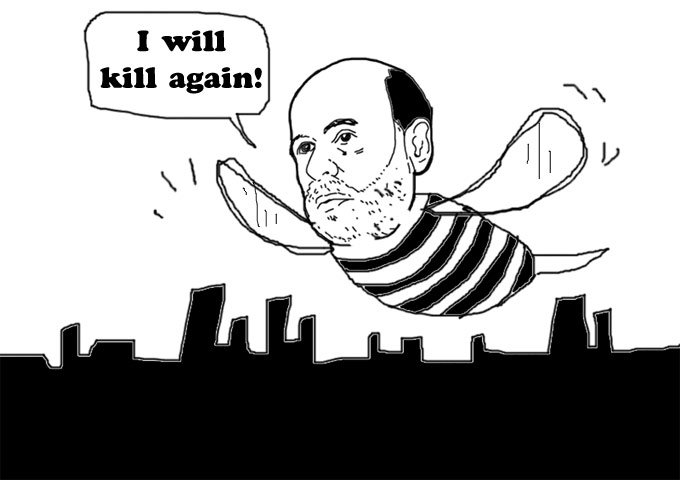
Uncle Ben said on “60 minutes” that “the FED could raise interest rates in 15 minutes if it had to.” well we will see if Ben meant it cause he will have to raise interest rates. That will be the most difficult 15 minutes of his life when he has to raise them, which will end his world and ends his fantasy where we will have a collision course with reality. Because remember the way the government was able too delay the crisis in 2008 which was “print money” expand, stimulate; the FED was able to buy up debt, buy up Mortgages, buy up treasuries. That’s what has kept this whole phony economy going, is the FED’s ability to constantly inject money; to keep buying Bonds and to keep bailing everybody out. When the FED has to deal with Inflation as a problem, when the FED sees prices rising, long term interest rates rising and now is force to raise rates. The FED can’t bail out anybody because it would be adding to the problem; the FED can’t buy Bonds when it’s the one selling Bonds, it can’t buy Mortgages when it’s one of the sellers of Mortgages. So it’s not going to be just the private sector trying to unload and the govt. coming to the rescue. It’s going to be the private sector and the govt. through the FED trying to unload and nobody coming to the rescue. So this is the decision the FED chairman doesn’t want to have to face; raise interest rates or just keep inflating and say “I lied” inflation is here to stay. I think the latter will happen but the FED will try to spin it in some double speak. It will probably go something like this “The increase is welcomed, it shows we have a victory over deflation, a little inflation is good for us.” They will try hard to rationalize why it’s okay so that they don’t have to put on the breaks; “Don’t worry inflation isn’t going to get too bad.” It will not work and it will rage out of control very… very… quickly.
All of this is going to happen and we will hear it from the puppet master himself on Friday the 7th of January when Uncle Ben gives his speech before the budget committee. This disaster will occur in 2011 and will probably happen in the next couple of months.
Is it possible that this move up in Bond yields is all a façade? Then the scenario is going to be pushed back and we will get some longer rope to hang ourselves later on. But their may be some real money and real power behind these recent moves in the Bond Market. It’s not just Bonds; look at some of the charts in commodities, Silver, Gold, Crude Oil, Soy Beans, these markets look like they are going a lot higher. I think it’s more than just a coincidence this is all happening and happening at a time when the Chinese are finally having to face the music when it comes to the inflation that resulted from their foolish currency peg.

Thursday, November 4, 2010
We Won't Get Fooled Again!
Consider the Following:
- The FED reduced the interest rate charged to the banks to near 0%. The push was on to improve their (Banks) performance in hopes they could overcome the large losses from the default mortgages that they hold.
- Problem is few businesses an individuals wanted to borrow the money from banks due to the political an economic conditions that they face daily in the market place. Banks could not loan out the cheap money and make profits on the spread!
- Now the FED will buy U.S. Bonds held primarily by the same banks to again infuse money into them and take the risky debt of their books. The hope is the banks will lend out this money to small business and consumers to spur growth in the economy.
- Not So Fast - Banks will take the new cash and put it to work in foreign currency's, and stocks plus Gold. They will make money and our economy will not grow. It's another bailout for banks holding ever decreasing mortgage's. We get fooled again!
Thursday, October 21, 2010
All the President's Men!
 |
| Economic Freedom is a mind-set! |
I am often asked which U.S. presidents pursued the best and worst economic policies. My answers may surprise you. In evaluating a President, I believe it is essential to look past his popularity, party affiliation and family background. During the twentieth century, there were several presidential standouts - both good and bad. I want to discuss one of each. In both cases, their policies changed the direction of the entire nation, affecting the lives of millions of Americans.
Silent Cal
Calvin Coolidge was Vice President under Warren G. Harding, who became President in 1921. At the time, the United States was in a deep depression. Unemployment was at 20 percent, taxes were high and federal debt was ballooning. Harding insisted on cutting taxes, reducing the national debt and cutting the federal budget (the opposite of what his predecessor, Woodrow Wilson, had done). Following Harding's sudden death in 1923, Coolidge wisely chose not only to maintain many of those policies, but to extend them.
In his first address to Congress, Coolidge called for further tax cuts, fewer subsidies and avoidance of foreign entanglements. "Perhaps the most important work that this session of the Congress can do," Coolidge said, "is to continue a policy of economy and further reduce the cost of government." Coolidge had a deep understanding of the need to limit government growth. His belief in property rights was reflected in his commitment to cutting taxes. "I want taxes to be less," said Coolidge, "so that the people may have more." Coolidge signed into law Revenue Acts that lowered income tax rates from 73 percent to 24 percent. He, together with Harding, also cut federal expenditures in half. "Anybody can reduce taxes," Coolidge said, "but it is not so easy to stand in the gap and resist the passage of increasing appropriation bills which would make tax reduction impossible." Where were the results of these policies?
It is no coincidence that the Harding/Coolidge era was one of the most prosperous in U.S. history. Gross National Product, wages, profits, productivity and the overall standard of living rose substantially. Although he was quite popular and faced no term limits, Coolidge refused to run for re-election in 1928. Today, it is rare to find any politician who wishes to self-limit his time in office.
Cal's Successor
When Coolidge decided to step down, Herbert Hoover - who was Secretary of Commerce for both Harding and Coolidge - secured their party's nomination and went on to win the presidency. Hoover served just one term in office. During those four years he essentially reversed the course of federal policy. Hoover pushed for higher taxes and farm subsidies, and proposed costly pension entitlements. He also signed the infamous Smoot-Hawley tariff bill, a protectionist policy that helped cause global economic depression.
Under Hoover, federal spending roughly doubled and personal income tax rates jumped from 25 percent to 63 percent. He raised corporate taxes, too, and doubled the estate tax. Hoover also pressured business leaders to keep wages artificially high, contributing to massive unemployment. By the time he left office, the U.S. economy was in shambles and the Great Depression had arrived.
Hoover is rightfully blamed for much of the economic calamity that left millions of Americans unemployed and penniless. But it is wrong to say he caused the Great Depression by following free-market principles. Hoover did just the opposite. He undermined economic freedom. Those mistakes were then compounded by Franklin Delano Roosevelt's "New Deal," which prolonged the Great Depression. Rex Tugwell, an architect of FDR's policies, wrote: "we didn't admit it at the time, but practically the whole New Deal was extrapolated from programs Hoover started."
Election Time!
The United States is not electing a president this year, but hundreds of other important offices will be on the ballot Nov.2. When evaluating a candidate for public office, I ask a simple question: Does the candidate support economic freedom? Economic freedom does not "belong" to any political party. After all, both Coolidge and Hoover were Republican. Candidates of any party who believe we need bigger government, more regulation, higher taxes, increased spending and borrowing, and more centralized decision making are threats to economic freedom. Like Hoover, their policies leave all of us - especially the poor - much worse off.
Candidates who support economic freedom realize our government is already too big and intrusive, and is spending, borrowing, taxing and controlling too much. They support a strong and efficient government, but one that operates within strict Constitutional limits and in the best long-term interests of society. If you are concerned about creating jobs, growing our economy and enhancing our quality of life, then you need to be concerned about electing candidates that support freedom. This is true everywhere and at all times, not just in the United States this November.
Thursday, September 23, 2010
Decision Time!
 |
| We need another "New Hope" |
After wrestling with the worst recession in a lifetime, many governments are now facing an even bigger economic challenge : what to do next. While the issues are complex, the debate over next steps essentially boils down to two schools of thought: First, there are those who urgently insist we need to spend more - even if it requires borrowing money - in hopes of stimulating something better. Second, are those who insist we must get in the habit of spending less and paying down debts to avoid making things worse. Everyone agrees that the consequences of a wrong decision could be enormous.
WHAT HAPPENED?
For years, individuals, businesses and governments lived far beyond their means. They borrowed excessively at government-induced, artificially low interest rates and then went on spending sprees. All that spending appeared to be great for the economy, which grew at a rapid rate because of artificial stimulation. But what was growing even faster was a mountain of debt and bad investments. Consequently, when the economic meltdown began in 2008, its effects were fierce.
As the recession spread from the United States to Europe and beyond, credit downgrades and defaults reached record levels. The global financial system appeared to be near collapse. Home values , commodity prices, stock values, currency rates, interest rates and fixed income assets collapsed. Unemployment rates began to soar, aggravated by government barriers to the mobility of employment.
Governments in the European Union and the United States reacted by pouring trillions of euros and dollars into "relief" and "stimulus" programs intended to restart the economy. But these actions undermined true prosperity. With the government directing the economy, resources went to satisfying political desires rather than the desires and values of individual consumers. Of course, since there was no cash on hand for those programs, governments borrowed and central banks created even more money to fund these efforts.
WHAT THEN?
Many families and businesses are now slowly paying down their debts and spending less, especially for things that aren't essential. That's why sales of new homes and automobiles (overbuilt due to easy money and government subsidies) have slumped.
When the U.S. government tried to stimulate sales of those products (through the "cash for clunkers" program and first-time home buyers tax credits), sales briefly rose, but then dropped after the programs expired. The drop in demand for goods and services created a decline in industrial production that was seen around the world. In Japan, industrial production dropped 40 percent from it's early 2008 peak. Even China suffered.
Since so much of the world's economy depends on consumer spending, this newly frugal behavior has meant a slow-growth economic environment. The U.S. economy grew at an annual rate of just 2.4 percent in the second quarter of this year, following a revised 3.7 percent rate in the first quarter. That compares with growth rates of 5.1, 9.3, 8.1 and 8.5 percent in the first four quarters following the next worst recession since World War II.
ON THE OTHER HAND!
So, if individuals and businesses have decided it's wise to trim their spending and pay down debt, what are governments doing? Just the opposite. In fact, additional deficit spending by the U.S. government has more than offset any private sector improvements. Keep in mind, this additional government spending is financed with borrowed money. Most governments were already running serious deficits before they tried stimulate any recovery.
According to the International Monetary Fund, advanced economies - like those of the United States, Japan and Europe - now have public debts that are averaging more than 110 percent of gross domestic product. (Emerging economies, such as India and China, are below 40 percent.) At some point, a nation will have no reasonable hope of repaying its debts. The inevitable result is some sort of default, whether through outright bankruptcy, a restructuring of payments or devaluation of the currency.
WHAT NOW?
The good news is that the global recession appears to be over....for now. In general, the Asia-Pacific region fared better than the rest of the world. By comparison, Europe is in much worse shape and the United States is somewhere in between. I believe near term expectations are sobering and not likely to excite peoples belief in a real recovery. The economies of Europe and the U.S. are likely to be in a relatively weak, slow-growth mode for several years.
Recoveries following serious housing busts and credit crunches typically take four or five years as banks and households focus on the hard work of rebuilding their finances. The process for a government to get out of debt is even harder, especially in a slow-growth environment.
DEBT BINGE!
In Europe, assistance to Greece and other nations has already cost European taxpayers far more than expected, causing some to balk at any notion of taking on further debt to bail out over-extended economies. The Government of France disagrees with taking a conservative approach, and suggests that even more must be done - if necessary - to preserve the European Monetary Union. In the midst of all this disagreement, there are some encouraging signs.
Ireland's government, for example, has already settled down to the painful task of cutting spending and repaying debt. In the United Kingdom, Prime Minister David Cameron and his coalition government are doing the same. Britons have been told that a difficult period of "new austerity" is unavoidable if there is to be any hope of cleaning up their dire fiscal mess. (Government spending in the United Kingdom - as a percentage of GDP - is even higher than that of hapless Greece.)
FUNDAMENTAL DIFFERENCES!
Europe's experience is another reminder, if one were needed, that every country with sustained budget deficits and rising debt ... needs to act in a timely manner to put in place a credible program for sustainable fiscal policies. This sort of thought process does not sit well with those urging the government to spend even more borrowed money on further "stimulus" for the shaky economy. Obama says we haven't spent enough! Many who might have agreed with that policy a few years ago now disagree with his policy ideas.
There is nothing progressive about a government who consistently spend more than they can raise; there is certainly nothing progressive that endows future generations with the liabilities incurred by the current generation. While painful and slow in the short term, it is essential that we allow our economy to adjust. If politicians try to intervene and prevent or postpone this necessary adjustment, we run the serious risk of not just a double - dip recession, but a true depression. But, if we prevent further damage and begin to reverse the harm already done; we should be able to achieve positive long term growth rates. It's important to realize that prosperity is dependent on economic freedom. As citizens, are we going to advocate for economic freedom, or bigger government and lower well - being?
HISTORY LESSON!
Back when I was at the University of Florida I did a report on two Countries Argentina and Venezuela that undermined their own prosperity by instituting policies that undid what originally made them prosperous. They transformed themselves from free and prosperous societies into nations burdened by unemployment, escalating taxes and runaway inflation. Despite clear lessons from the past, many of the same misguided policies that have devastated those nations are now finding a home right here in the United States.
After decades of growth and spending in the United States, we now see many disturbing parallels with South America's failures. If you look at the past 10 years of expanding government bureaucracy, spending and debt, it's clear the U.S. is losing ground. As a nation, we are no longer generating prosperity for society as a whole. We will continue to lose ground until government policymakers understand that more spending, more debt, more regulation and more centralized controls of every aspect of life can not make us better off. The simple truth is that many of the "new" or "progressive" policies being promoted in the U.S. are old ideas that have failed throughout history. Why in the world would we want to repeat such serious mistakes?
THE STAKES
What's at stake in this struggle is the future of the United States. Americans who are concerned about our future must speak out if this course toward economic ruin is to be reversed. Tea parties, for example, reflect a spontaneous recognition by thousands of Americans that if they do not act, the government will bankrupt their families and the country. Although our efforts to draw attention to government overspending pre-date recent tea parties by many years, I certainly applaud those citizens that are becoming more engaged in key policy issues.
Citizens must hold lawmakers accountable for upholding the Constitutional principles of liberty and personal responsibility that helped the U.S. become productive and prosperous. There is too much to lose if we do not speak up - both to our elected officials and at the ballot box.
MY STANCE!
When it comes to public policy, I believe the U.S. - not to mention much of Europe - has been headed in the wrong direction for quite some time. Republicans and Democrats alike have been fiscally irresponsible, spending more than they should be borrowing like there's no tomorrow. As a nation, we are, quite literally, going bankrupt.
The upcoming elections in November will provide a prime opportunity to help steer things in a different direction. By educating ourselves on the issues and voting for those candidates that support economic freedom and prosperity, we have a chance to make a difference. To solve our nation's problems for the long term, we must remain principled and pursue practical, thoughtful solutions - solutions that can actually be implemented.
We need all citizens to speak out about wasteful government spending. That is the best way to get policy makers focused on the serious problems that spending and unbridled debt are creating. I will continue to advocate for economic freedom and market-based policy solutions because they are proven pathways to prosperity for all. To paraphrase Winston Churchill, a market-based approach to public policy may not be perfect, but it beats all the other alternatives that have been tried.
Subscribe to:
Posts (Atom)
